
Your Ultimate Guide to Planning A Content Strategy

So, you’ve decided to invest (time, money, or both) into content marketing – you’re sold on the benefits. Maybe you’ve already started blogging, or making videos, or even podcasting. Superb!
But do you really have a strategy in place for making all this content work for you? Do you know what your business is trying to say, how you want to present yourselves to the world, and ultimately, what you’re hoping all this content will lead towards?
Let’s face it, there’s more to content marketing than just generating more and more content. In fact – and although there are many businesses who just don’t create content at all, which is the opposite (and yes, probably worse) problem – many companies have more content than they know what to do with. It just sits there, on their blog, unused, and generally forgotten about – even by its creators! If you’ve forgotten about content that you’ve invested time or money into, then it’s a sure thing your audience won’t be rushing out to discover it either.
Yet this is the sad fate of most content. Once the hard work in putting it together is finally complete, it goes up onto your website. It’s Tweeted once or twice, maybe. It might get some attention on a ‘Throwback Thursday’ on your social media – but that’s if your business is especially diligent. Other than that, it gathers dust on your website, and tragically fails to make an impact on either your SEO or your brand authority, the two most common reasons content is created in the first place.
We’re here to tell you that in 2020, content marketing is about centralising, organising and distributing your content in a way that’ll get attention, drawing your potential customers into an environment where you control their content experience.

If you can deliver your readers an enjoyable experience of your content, you’ll send clear signals about the authority and reliability of your brand. How do you do that, I hear you ask? Strap yourself in, because that’s what our article today is all about!
Why Content Marketing?
Before we delve into the nitty-gritty of a content marketing strategy, and look at how your business can define a roadmap for success, we must first remind ourselves why we’re creating content in the first place.
- Show your business is authoritative – Frankly, producing content showcases your company’s expertise in a way that straightforward marketing copy just can’t. In a world that’s oversaturated with marketing, the chances are that regular sales spiel on your website just won’t cut through the noise. But to give an in-depth treatise on a key area of your business, in a fashion only a true expert on the subject area could? That proves that you’re the real deal. If people feel confident that they can trust the information you can give them, they’ll be far more likely to trust your brand enough to buy your products and services.
- Leveraging reciprocity – Your company gives – in (perfectly reasonable…) hopes of receiving. When people think they’ve received something valuable from you, they’ll be far more likely to make a purchase from you, as they’ll feel favourably about your brand. Costco publishes a free cookbook once a year, completely ad-free, which serves as marketing gold dust for the wholesaler. It shows Costco isn’t always just after profit, and that they’re trying to improve their customers’ day-to-day lives. In the end, the favourable brand recognition Costco enjoys as a result pays for marketing like this!
- Creating brand loyalty – People are far more likely to remember your brand if they learnt something important from you, or felt touched or moved by content you’ve put into their grasp – for free. By being a vocal, active brand, engaging with what’s going on in the world and commenting on your areas of expertise, you’re going to be far more memorable to your users than if you’re strictly business-focused. The trust your users will feel towards your brand translates into loyalty.
- It’s great for SEO – One of the most important reasons to churn out regular content is that search engines love to index well-produced content, particularly if it contains important keywords about the subject you’re talking about. Regular content is great for SEO! People tend to think this mainly applies to blogs, where search engines read your content and interpret your subject area – but actually, it doesn’t matter whether this is a video or a podcast, either. Google has had the technology to listen to, and transcribe, audio content for years now (that’s why YouTube’s video search generally works very well). Plus, with home voice-activated technology such as Siri and Alexa becoming all the rage, this technology is only becoming more advanced. Search engines also look for sites that are regularly updated – of course, if you’re engaged in content marketing, this won’t be a problem for you either!
As we hope we might have made clear, content marketing is much more than a few select words that tell your customers to make a purchase; it’s not a one-liner sales pitch that’s going to send them into a buying frenzy. Rather, it’s the strategic use of your internal resources and talent to craft a brand voice and focus on giving to your audience, knowing that if you do a good job, they’ll want to give back to you, in the form of their custom.
Who are you marketing to?
Once you’ve decided that content marketing makes sense for your business, the next step in the process is to clarify exactly who it is that you’re marketing to. When we’re tasked with doing this for our clients, we’ll typically create buyer personas based on the demographic profile, needs and concerns of a typical buyer for our client’s product or service.
Buyer personas are best imagined as fictional characters that allow you to better visualise who you’re marketing to, and what makes those individuals tick. The more fleshed-out your buyer personas are, the more targeted the content you can produce will be, and the idea is that you’ll get much more engagement and shares as a result.
Let’s say you’re a whisky manufacturer. Obviously, there are several different demographics who buy whisky (one of them is yours truly, a web designer who likes a tipple!). But maybe you happen to know from previous research that happen to fit a particular profile. You can use that information to create your fictional buyer persona.
Now, I don’t have a great deal of knowledge on the whisky market, so please don’t laugh. But let’s say you build a buyer persona based on your previous sales, and you come up with a buyer persona, Tim. Tim is retired and married, he likes going for walks and travelling when he can, and now that he’s not working, he’s got a taste for the finer things in life. Appearance matters to Tim, and he’s reasonably affluent, so he doesn’t mind spending on a drink to ‘experience’, rather than glug down!

Ha. Yeah right.
Tim could be someone you have in mind when you’re planning future content marketing for that whisky business. So, when you’re planning to write or record something in future, you can now have the person you’re writing or speaking to in mind. What would Tim appreciate from your content? And what types of content (video, blog, podcast, etc.) will better engage Tim? Perhaps he’ll have the time to sit down and read a blog about whisky, and doesn’t really get the whole YouTube stuff his grandchildren are into.
It’s all about digging deep to try to better understand your audience, and craft stuff they’re really going to enjoy.
You can also investigate what your target group of potential customers are talking about. Start by researching trending topics amongst your current customers – who are the influencers they follow (and what kind of content do those influencers produce)? Google Trends can also be a great help here, as it gives a picture of search volume over time. You’ll see what’s on everyone’s minds and lips, and then you can dive into content that either muses upon that directly, or at least touches upon the phenomenon it relates to.
Content that is relevant to your audience, and to current events, is far more likely to be effective, and earn the social shares which can lead to viral exposure.
HOW DO YOU MEASURE Content Marketing SUCCESS?

It’s the million pound question, eh?
Let’s imagine you’ve got to the end of your first content marketing project. The one, pressing question on your mind when the time comes that your content is fully distributed and all of your project tasks are done, should be “Did it work”? A follow-up evaluation should give you not only pause for thought on what you did right, but also ideas for future improvement. Content marketing, after all, is a continual process; one campaign should flow into another, with lessons applied from the experience gained in the previous.
Your company may well have one or two more industry-specific metrics by which measure your success, but ultimately businesses (shocker, we know) exist to make money. So, we’re going to take a wild guess that your number one metric has to be sales. Were they boosted after you finished up, or did your campaign barely register on the Richter scale?
Once your sales figures have been analysed, then you can look at other metrics of engagement. It could be that while your sales figures haven’t been much impacted – yet – your brand recognition went way up. Take the time to identify which of your Tweets, articles, videos, or podcasts got the best response and the most engagement, and if you can spot any patterns in successful and unsuccessful content, make a note of these. All of this stuff is gold dust for planning future content marketing campaigns.
Finally, you want to assess whether your internal processes as a company have been impacted at all by the results of your content marketing campaign. Has any actionable insight been gained that might impact how your sales team view their audience and tailor pitches, for example? Or perhaps your marketing team have come to the conclusion, led by data gleaned from your campaign, that your audience responds better to video content than written. This sort of insight can really be invaluable, so it’s really worth you making a note of anything like this as it’s an often unspoken benefit that might otherwise go overlooked.
Great Content Marketing Is Adaptable

As the title says, we believe that truly top-notch content marketing has an ability to change with the market, which can often switch gears at rapid pace. Truth be told, the process of calibrating, optimising, and tweaking should never end, if you’re doing it right.
Sometimes, that means spotting an opportunity based on a current event, and putting something relevant out there at pace.
The classic example of this was during the Superbowl, a huge event for marketers and advertisers, who often splash the cash each year to feature during its famed ad breaks when viewer figures are at their peak. As The Drum reported, Oreos ‘won’ the Super Bowl back in 2013, when during the famed power outage in the Mercedes-Benz Superdome, New Orleans, they Tweeted the following:
Power out? No problem. pic.twitter.com/dnQ7pOgC
— OREO Cookie (@Oreo) February 4, 2013
Now, that was a speedy response, making the best of an unforeseen circumstance to get an amusing bit of content out there into cyberspace. The result was 15,000 Retweets, and I’d love to see the figures for sales and brand searches internally afterwards! I’m sure whoever came up with that one got more than a few pats on the back from top brass!
Content Marketing is your brand
Remember how we talked earlier about how your content marketing strategy effectively acts as the voice of your brand online, and serves as a way to demonstrate both what it is you do, but also what you stand for? That’s a holistic approach to content marketing. This means you shouldn’t look at creating content as just a way of selling your brand – in a very real sense, it is your brand. It isn’t a means to an end – it’s part of the end itself.
What does this mean for the way you look at content? For one thing, it should mean that you shouldn’t just churn out content to hit a deadline, or target. “1,000 words a day”, as a blogging strategy, for example, might sound great, and from a purely number-crunching, SEO-focused point of view, it might even score your brand some brownie points on Google Search.
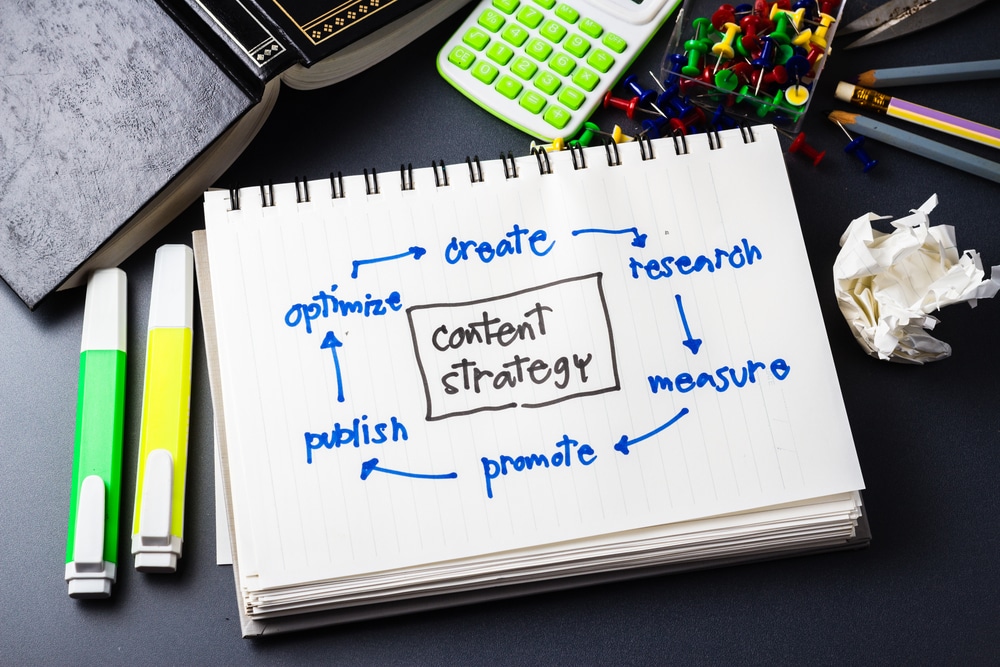
But what kind of quality is that content going to be? Is it going to be inspired content, content that’s both topical and unique in the perspective you bring to it? Or is it content that’s just there because you know it’s the ‘done thing’ to do in marketing?
Don’t get us wrong. If your business has the resource and talent to produce quality content every day, have at it. But you shouldn’t underestimate how difficult really good content is to produce. It can’t be a box-checking exercise. When you get content right, it can quite literally explode your brand exposure through social sharing, send torrents of backlinks your way, and even get newspapers and other media talking about you – but we’re talking the kind of content that’s truly groundbreaking, the kind of content that is a true leader in its field. That stuff doesn’t grow on trees, and it often takes weeks or even months to produce.
You should view all of the content your business produces as being part of the brand experience you are offering. Whatever your brand is, and whatever its values are, must be expressed in the content you produce. If your content is poorly written, irrelevant, or heck, even outdated, you should get rid of it. Ask yourself “Does this piece of content reflect how we’d want to be seen by a potential client?”. If the answer is no, let it go!
What stage of the buying process is your content for?
Heard of the buying process before? It comes in four stages, and basically covers the different levels of intent users of your website may be in, depending on their familiarity with your brand or exposure to your previous content marketing. These stages are:
- Awareness and discovery – when they land on your website, potentially after realising that they need something (which could be just a piece of information, that you discuss on your blog). Content for this phase should center on building brand awareness. But don’t force it – as long as you’re giving good information that your reader will appreciate and remember, you’re building brand awareness naturally.
- Consideration – Once the user becomes aware of who you are and what you do, there’s a decent chance they might become interested in what it is you have to offer. For example, if you’re a craft ale retailer, you might write a beginners’ guide to the different types of beer, which might lead your reader to want to try the products you sell (after all, you seem to know what you’re talking about!). As soon as they’re asking themselves the question of whether to buy from you, they’re in the consideration phase.
- Purchasing – Ker-ching! Now we’re talking. In the third stage, your customer has decided you’re worth their hard-earned cash. Maybe they’re now wondering about technical details such as means of payment, transportation, return policy (OK, probably not for the craft beer, but you get the idea…). These guys are ones you might target content about potential discounts, membership packages, price guides, and so forth.
- Advocacy (and re-conversion) – In this stage, your customer has tried your product, and (hopefully) likes it enough to become an advocate for it. Word-of-mouth marketing can still be powerful even in our trailblazing digital age, so your content marketing could make room for it – by encouraging customers to share experiences on social media with incentives such as a prize draw, for example, or offering a gift for referrals.
Now that you know about the four phases, why not try to incorporate pieces of content for each stage in the buying journey? In doing so, you’ll be forging a cohesive content experience for customers, that will help smooth the process from a brand new user first coming into contact with your brand, to a passionate advocate of who you are and what you do, helping win other customers for your business.
Make 2020 the year your business launches a winning content strategy
We’ve covered a lot in this article, so let’s run a quick re-cap. The best way to look at your content marketing is as an extension of your brand. As such, it needs to reflect on the values you have as a company – strictly so, and content that doesn’t meet the mark should be mercilessly deleted!
To produce great content that will engage your audience, you need to understand who those people are; the people you’re writing for and ultimately selling to. To do this, you can build a buyer profile (or several) for the different people you’ll sell to, and plan your content for those fictional characters. The idea is that they’ll represent your typical customer, so by tailoring content to their needs, you’ll increase your engagement and the impact your content has.
Finally, you’ll want to ensure you have content for customers at each stage of the buyer journey. Do you have good content to welcome users who are unfamiliar with your brand, and show them what it is that you do? Can you guide people in the “Consideration” phase to the realisation that what your brand offers is unique (hopefully turning them into “Purchasers” of your product or service)?
Start to view your content as part of your wider brand identity. It’s not a method for selling, but a way to give value to your industry. This subtle change in approach can be responsible for powerful content that speaks from the heart, and will help your brand distinguish itself from your competition.
Hopefully, this article has given you an idea or two about how to get your content strategy rolling in 2020. If you’d like expert consultation on building a content strategy that will get you noticed this year, don’t hesitate to get in touch with us.

- How to redesign your site without losing SEO - December 12, 2025
- Is your business invisible to ChatGPT? The rise of Answer Engine Optimisation - December 9, 2025
- The Zombie Content Apocalypse: Why Deleting 30% of your Site Could Boost Your Traffic - December 9, 2025
GOT BIG IDEAS?
Inspired to start your own content strategy in 2020, with a game-plan to engage your audience and create major ripples in your sector? We’re here to help you build something big.
Please use the form below to let us know of your grand designs – whether for an online marketing campaign, a new website, or a funky rebrand – and we’ll be back in touch to (hopefully) help make them happen.

